

When an executive buyer or founder visits your B2B website, they are not evaluating it like an art gallery. They are looking for immediate proof of competence, clear operational alignment with their problem, and reassurance that partnering with your company will not carry professional risk. In B2B markets, website design is a visual trust verification engine that directly influences deal size and sales cycle duration.
Quick Summary / TL;DR
- B2B website visitors evaluate credibility in under 50 milliseconds; visual clarity and professional typography set the baseline expectation.
- High-converting B2B design prioritizes problem-first messaging, transparent process roadmaps, and verifiable social proof.
- Complex navigational clutter, stock photography, and vague slogans actively undermine enterprise trust.
- Structuring landing pages around cognitive friction reduction dramatically increases qualified sales consultation bookings.
- A high-trust design system directly enhances pricing power and accelerates enterprise sales deal velocity.
- Accessible, high-contrast layouts ensure seamless evaluation across all desktop and mobile devices.
The Psychology of the Skeptical B2B Buyer
Unlike consumer shoppers buying personal items, B2B decision-makers risk their professional reputation when selecting a vendor. If a project fails or a contractor underdelivers, the manager who recommended the partnership faces internal scrutiny.
Consequently, B2B buyers arrive at your website with inherent skepticism. They look for red flags: generic stock photos of people shaking hands, ambiguous descriptions of services, missing case study details, or broken mobile layouts. If your website looks amateur, buyers assume your service delivery will be equally careless.
Effective design eliminates this anxiety by demonstrating structure, precision, and technical competence across every page element.
Enterprise decision-makers do not read web pages word for word; they scan for structural validation markers that confirm your business has successfully delivered similar outcomes for reputable peers.
High-Trust B2B UI Design vs Low-Trust Website Traps
Examine the visual and architectural differences that separate high-converting enterprise websites from low-trust sites:
| Design Element | Low-Trust Traps (High Bounce Rates) | High-Trust Enterprise Design (High Conversion) |
|---|---|---|
| Hero Section Copy | Vague slogans: "We provide innovative 360 digital solutions" | Specific problem & outcome: "We build custom Next.js web applications that scale" |
| Visual Assets | Generic stock photography from free image libraries | Real product interface previews, annotated architecture diagrams, actual team photos |
| Proof Placement | Buried at the very bottom of the page in small text | Prominently placed client metrics, logo bars, and verified case studies near the hero |
| Navigation Structure | Overcrowded menus with 12+ links and nested dropdowns | Streamlined navigation focused on core services, case studies, and a clear primary CTA |
| Form & Booking UX | Lengthy 10-field forms asking for unnecessary personal data | Frictionless 3-field forms or direct interactive calendar booking links |
| Typography & Contrast | Low-contrast light grey text on white backgrounds | Crisp dark charcoal typography (#09090b) with generous line-height |
| Service Deliverables | Abstract lists of buzzwords with no clear scope boundaries | Detailed step-by-step service roadmaps with explicit milestone definitions |
The 4 Visual Trust Principles of High-Converting B2B Websites
Incorporate these four principles into your design system to establish immediate authority:
1. Establish Clear Visual Hierarchy and Typography Discipline
Use high-contrast, professional typography (such as clean modern sans-serifs) with distinct heading scales. Ensure line lengths do not exceed 75 characters on desktop for optimal reading comfort.
A disciplined typography hierarchy allows scanning executives to understand your core capabilities within seconds of landing on the page.
2. Show the Product and Process Visually
Do not make visitors imagine how your service works. Show screenshots of actual software interfaces, workflow diagrams, or step-by-step service deliverables. Visual concreteness reduces perceived risk.
Annotated diagrams and step-by-step process maps make complex technical services understandable and tangible.
3. Anchor Claims with Measurable Case Evidence
Replace generic testimonials (such as "Great work, highly recommended!") with structured case summaries: the client's starting problem, the exact solution implemented, and the measured commercial outcome.
4. Eliminate Cognitive Friction at Conversion Points
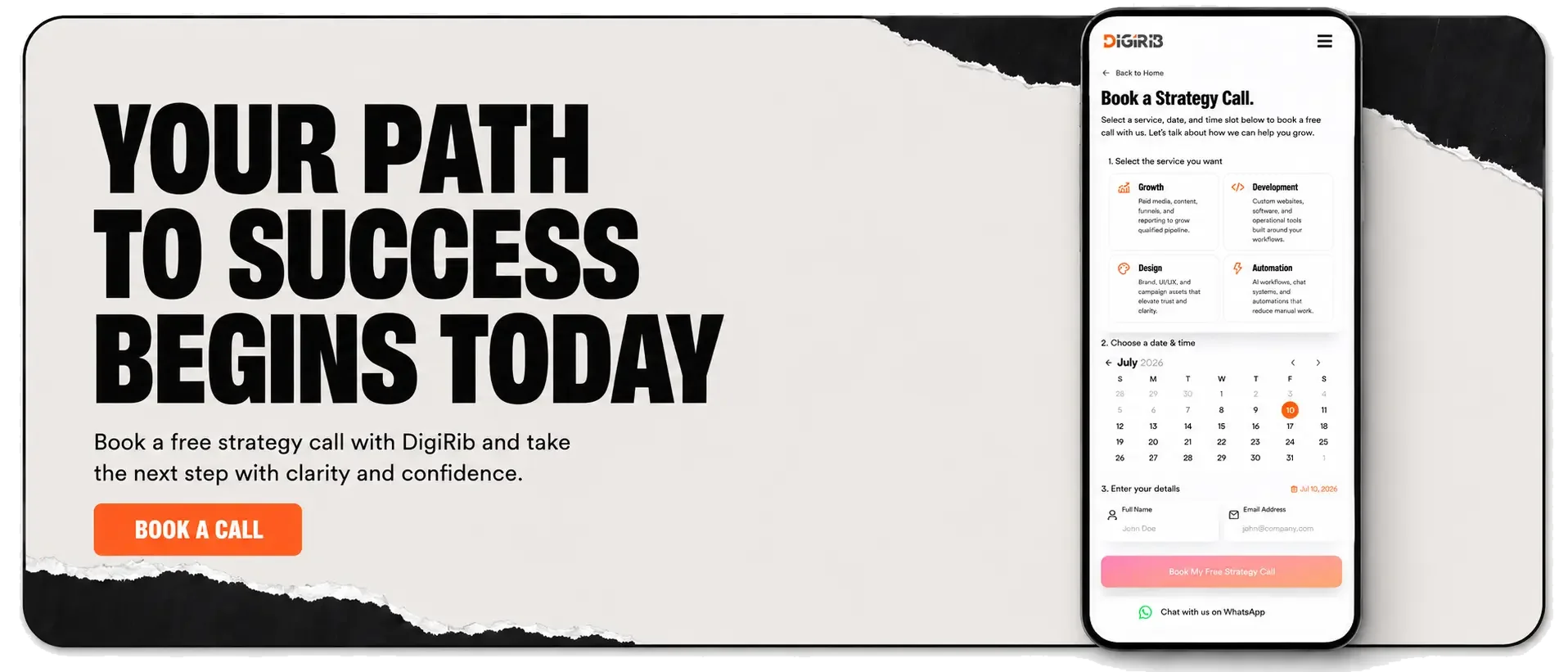
Ensure call-to-action buttons use high-contrast brand accent colors (such as DigiRib orange) and explicit action text (such as "Book a Strategy Call" rather than "Submit").
The 15-Minute B2B Website Trust Audit
Run through this rapid audit checklist to identify trust leaks on your current website:
- Check 1: Does the above-the-fold hero section clearly explain what you do in 5 seconds without scrolling?
- Check 2: Are client logos and verifiable credentials visible within the first two viewport scrolls?
- Check 3: Does the page load in under 2 seconds on a 4G mobile connection with zero layout shifting?
- Check 4: Is the primary call to action consistent across the entire page layout?
- Check 5: Are forms tested and integrated with instant confirmation and calendar links?
Designing High-Impact B2B Case Study Cards
A high-performing case study layout avoids long, rambling paragraphs. Structure each case presentation with four clear visual markers:
1. The Starting Bottleneck (e.g. 70% mobile bounce rate and slow server response times)
2. The Implemented Engineering Fix (e.g. Next.js serverless rebuild and PostgreSQL optimization)
3. The Quantifiable Business Result (e.g. 140% increase in booked sales consultations in 60 days)
4. Verifiable Client Attribution (e.g. Client executive title and industry sector)
References and UX Research
1. Nielsen Norman Group. (2024). B2B Website Usability Guidelines and Trust Heuristics.
2. Stanford Web Credibility Research. (2024). Visual Design and Authority Perceptions in Enterprise Software.
3. Journal of Marketing Management. (2024). Trust Signal Placement and Enterprise Conversion Rates.
4. Baymard Institute. (2024). UX Benchmarks for B2B Service Navigation and Form Flows.
Key Takeaways
- B2B website design is an exercise in risk reduction and visual trust verification.
- Specific problem-led headlines outperform generic marketing slogans.
- Visual proof, diagrams, and concrete case studies eliminate buyer skepticism.
- Clean typography and streamlined forms significantly increase meeting booking rates.
- Eliminating cognitive friction transforms casual site visitors into qualified sales calls.
Frequently Asked Questions
Why do generic stock photos damage B2B website conversion rates?
Stock photos look artificial and convey that a company lacks real clients, facilities, or original work. Authentic product screenshots, actual team photography, and original diagrams build significantly higher credibility.
How many fields should a B2B consultation form have?
For initial inbound inquiries, 3 to 4 fields (Name, Work Email, Company URL, and Project Goal) are ideal. Shorter forms maximize initial lead volume, and detailed qualification can occur during the discovery call.
What is the most common design mistake on B2B service websites?
The most common mistake is writing hero copy that focuses entirely on the agency itself ("We are a passionate creative team") rather than focusing on the client's urgent business problem and how to solve it.
How does whitespace affect user perception of an enterprise brand?
Generous whitespace creates a feeling of luxury, calm, and confidence, preventing the cognitive overload associated with cheap, cluttered marketing websites.
Should our website feature dark mode or light mode for B2B audiences?
For B2B service and enterprise consulting websites, a crisp light mode with high-contrast text and warm neutral surfaces provides superior readability and professional authority.
How can we measure whether a website redesign increased trust?
Measure metrics like average session duration, bounce rate reduction on service pages, and most importantly, the visitor-to-meeting booking conversion rate.
How DigiRib Delivers Conversion-Focused Creative Design
DigiRib crafts bespoke brand identities, design systems, and web interfaces tailored for B2B conversion. Our Design team bridges the gap between aesthetics and revenue, creating digital experiences that establish instant credibility.
We design clean, responsive interfaces that guide prospective clients smoothly from initial curiosity to scheduled consultations.