
RIB Pilot is DigiRib's SKU-first inventory chatbot product. Related service: AI and workflow automation.
Illustrative product preview: interfaces, calculations, integrations, and outputs shown below are demonstrations, not verified performance results.
Current Stage
Response Workflow
Product Matching
Order Confirmation
Drag the slider to compare an illustrative manual inbox with a proposed assisted catalog workflow. Real response and confirmation behavior depends on the approved implementation.
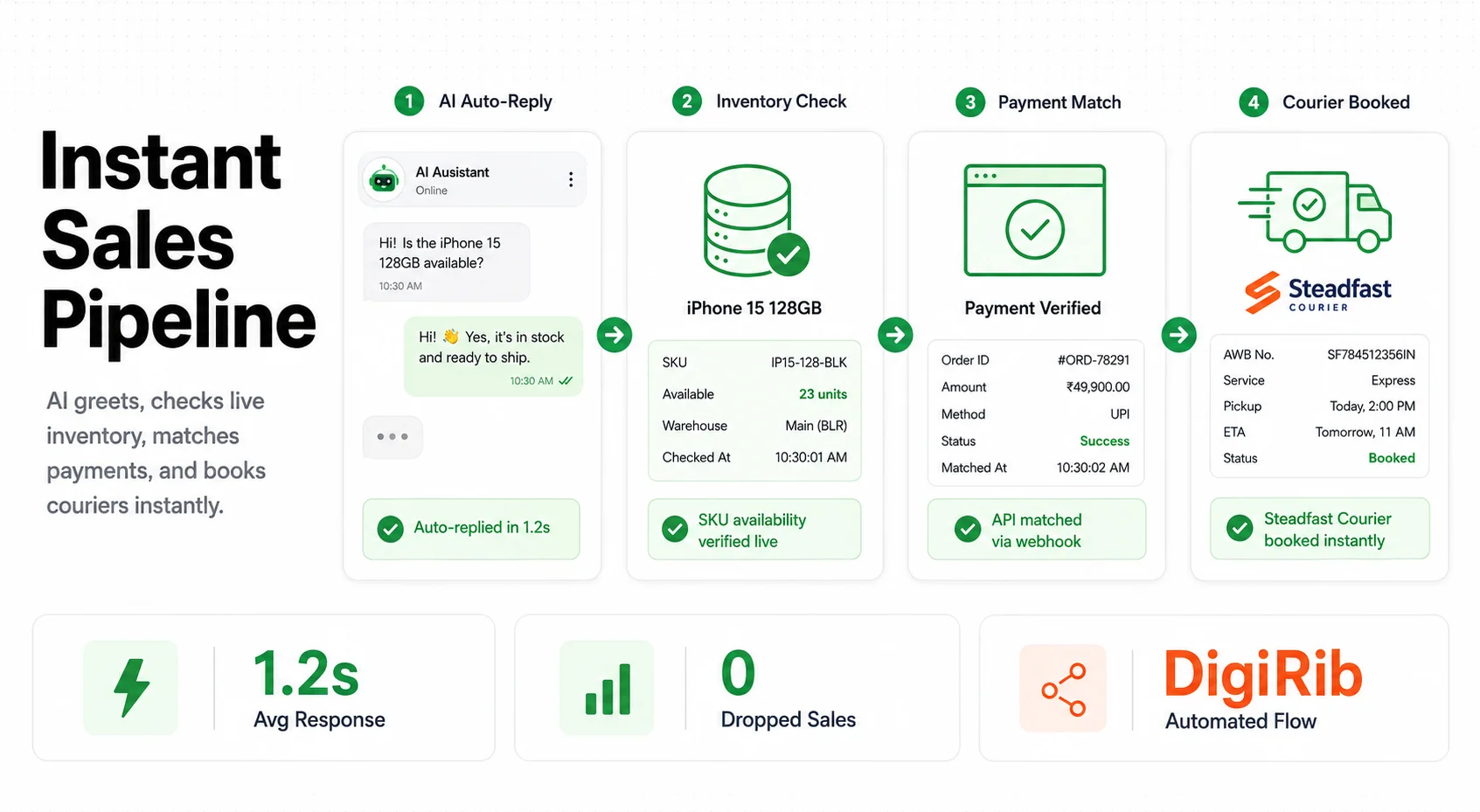
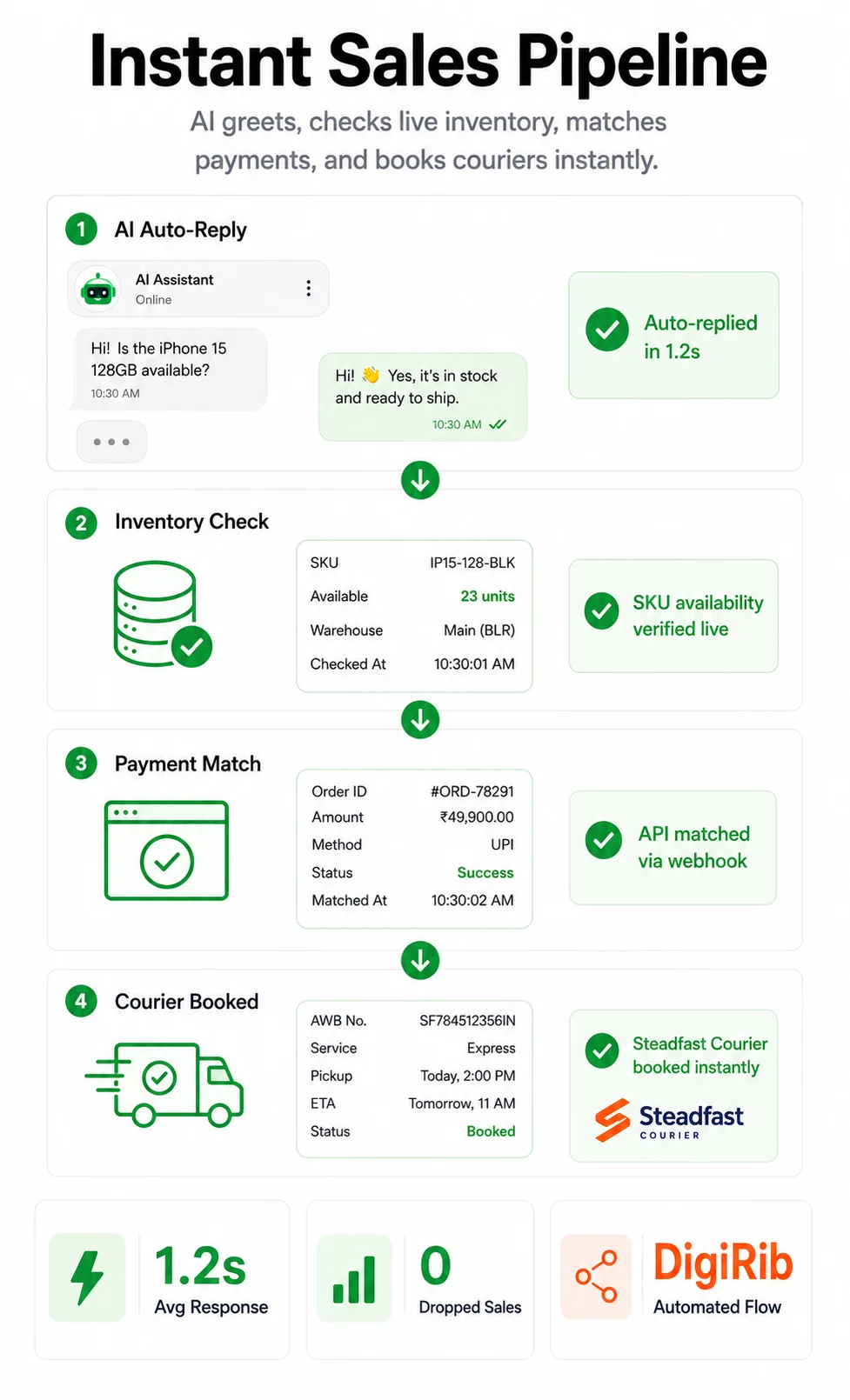
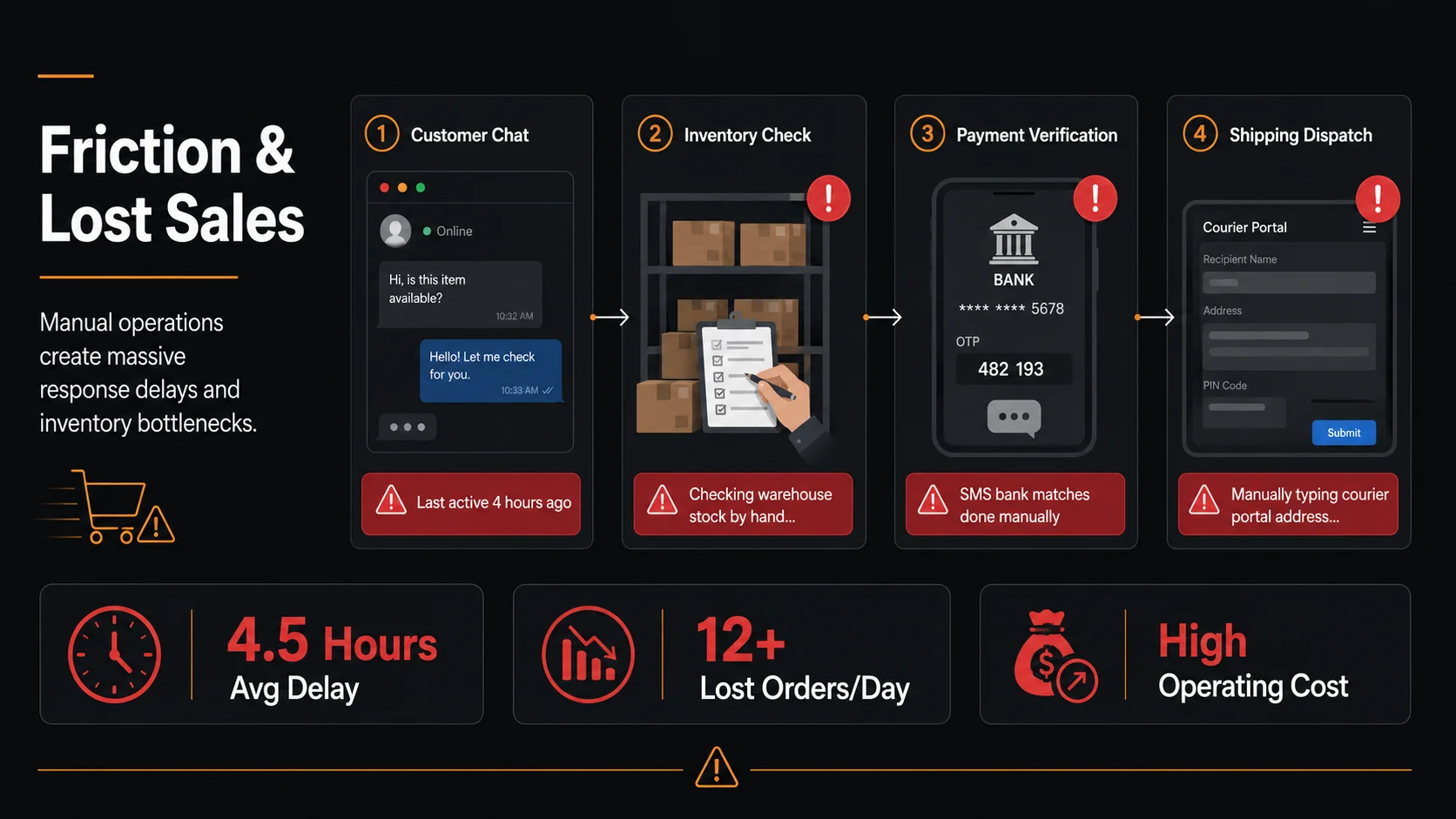
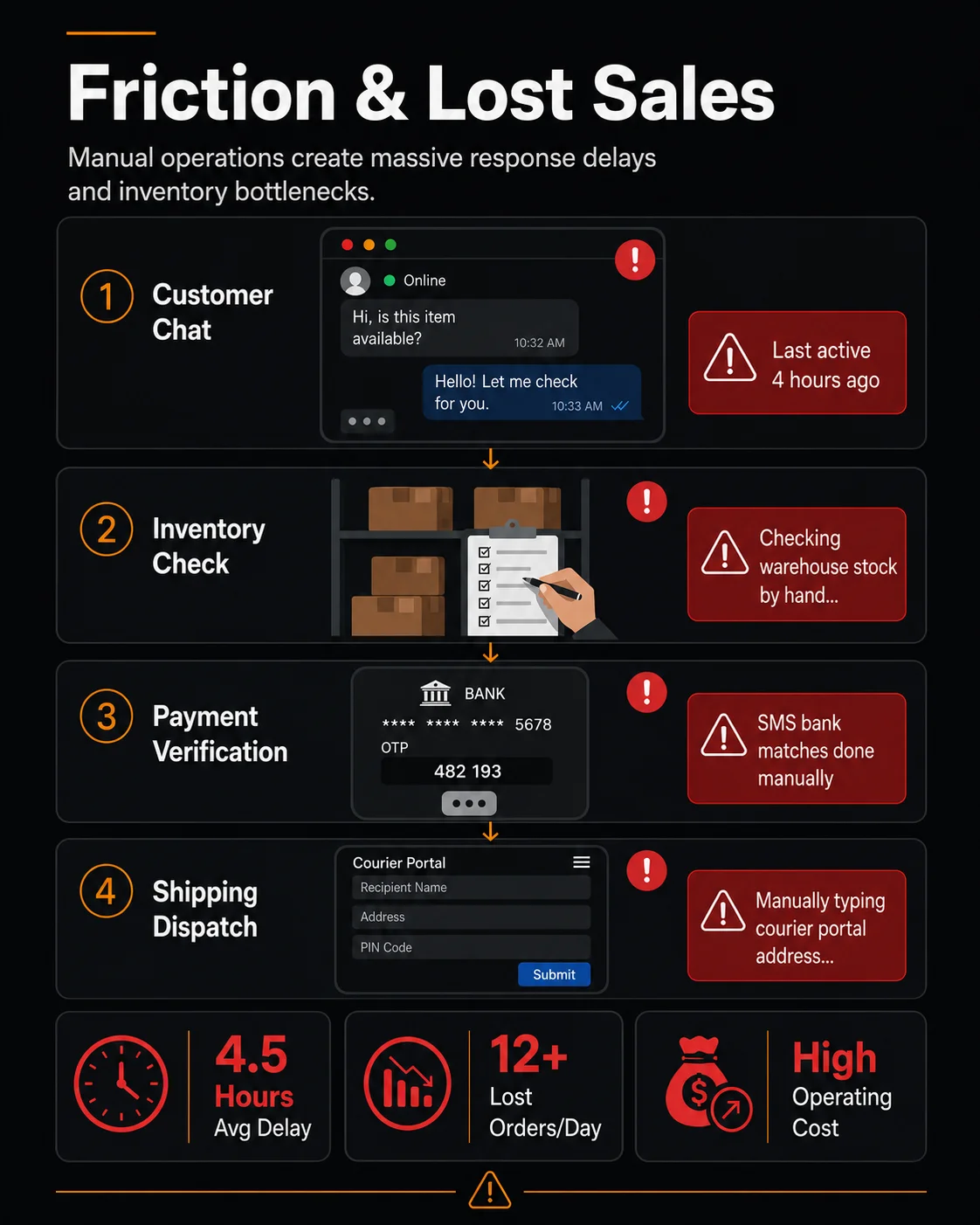
Adjust the assumptions to explore a hypothetical scenario. This is not a forecast, guarantee, or statement of measured RIB Pilot performance.
Example output from the assumptions shown above; actual results vary.
Example only; validate against your own inquiry and handling data.
Sellers in Bangladesh receive messages written in Romanized Bangla (Banglish). Rib Pilot resolves local language nuances automatically, translating raw messages into structured database queries.
Select a sample Banglish query from the left panel to execute parsing pipeline.
See how Rib Pilot handles real customer inquiries. Try selecting one of the triggers to simulate visual SKU detection, stock lookup in Supabase, payment checks, and automated delivery scheduling.
RIB Pilot is being designed around catalog retrieval and reviewable visual matching. Matching thresholds, fallbacks, and human confirmation are configured during a pilot.
Recognizes product codes and names instantly in customer messages. Replies with live prices, available sizes, and stock counts.
When customers send photos of clothes or items, our visual check narrows down candidate products from your catalog so buyers find exactly what they want.
No complicated database setup. Simply upload your product catalog using Excel or CSV files. New items and price changes sync in seconds.
When a customer needs human assistance, the system instantly alerts your team on WhatsApp or Slack so you can reply personally.
Manage conversations and orders from Facebook Messenger, Instagram Direct, and WhatsApp Business API from one unified dashboard.
Connect payment verification and local courier tracking so your orders move from initial conversation to doorstep delivery without manual delays.
This diagram shows a proposed connector architecture. Each channel, payment, and courier adapter is subject to provider access, technical validation, and the approved pilot scope.


Upload your inventory, connect your channels, and let the assistant answer product inquiries and help close sales.
Simply upload an Excel or CSV file with your product names, codes, prices, and photos. Your catalog is ready in seconds.
Link your Facebook Page, Instagram account, or WhatsApp in a few quick clicks with secure Meta access.
The assistant answers customer questions, checks available inventory in real time, and helps capture confirmed orders automatically.
Pilot availability, onboarding scope, supported channels, and commercial terms are confirmed directly with each participating business after technical discovery.
We construct custom chatbot systems that can use Retrieval-Augmented Generation (RAG) and vector databases such as Supabase pgvector, trained on the documents and catalogs you provide. Access controls, encrypted API paths, and row-level policies are used where the architecture requires them. Data handling is defined in the project scope; we do not claim that any system is automatically private in every configuration.
Integrations are scoped per project. Common channels include Facebook Messenger, Instagram Direct, WhatsApp Business API, and web widgets, when provider access is available. Backend sync can use n8n or equivalent automation to update a CRM or database. Exact platforms are confirmed during discovery.
Yes. By connecting directly to your database or e-commerce platform (Shopify, WooCommerce, or custom databases) through secure REST APIs, our AI chatbots can fetch product inventory, check real-time order tracking status, and trigger automated abandoned cart recovery sequences on WhatsApp and Messenger to re-engage customers and drive conversions.
We implement a seamless hybrid support workflow. When the chatbot encounters a complex request, detects negative user sentiment, or if the user explicitly asks for a human, it triggers an instant handoff alert. The system routes the conversation directly to your team on Slack, WhatsApp, or live-chat dashboards (like ManyChat or Crisp) and pauses autonomous AI replies for that user.
Ownership, licenses, third-party components, and handoff terms are documented in the statement of work. DigiRib prefers client-owned accounts and a clear transfer of custom workflows and prompts, subject to the signed agreement and platform rules.
Onboarding and system mapping are completed within 3 to 5 business days, where we set up shared Slack channels and audit your datasets. The complete design, database engineering, training, and deployment of a fully customized RAG chatbot system takes between 2 to 4 weeks, ending with thorough accuracy verification and user training.
Language support is scoped to the languages the project actually needs. For Bangladesh work that is typically Bangla and English. Broader language coverage depends on the model, prompts, and review process agreed in the statement of work.
We restrict the chatbot's working context to the client's verified materials and add fallback or human-handoff rules when confidence is low. That reduces speculation. It does not make replies automatically correct in every case, and production behavior still depends on the documents, prompts, and review process agreed in the project.
Yes, we can extend your chatbot pipelines to voice channels. By connecting voice-agent APIs (like Vapi, Retell AI, or Twilio) with our n8n backend, we can engineer custom voice agents capable of answering phone calls, scheduling customer appointments, or answering FAQs over the phone with low latency and human-like voice characteristics.
Rather than charging per-agent seat, we deploy systems using your own API credentials (OpenAI, WhatsApp Business, Supabase). You only pay the direct raw usage costs, which are fractions of a cent per message. We build in query rate-limiting, context caching layers, and token optimization protocols to keep your operational overheads as lean and predictable as possible.